Before you build an AI agent, someone has to write its rules.
Agent Master is a diagnostic I built that answers two questions most teams skip: does this problem actually need an agent — and if it does, exactly how should it be allowed to behave?
Everyone's shipping agents. Almost nobody's defining them.
Teams under pressure to "add AI" jump straight to building. What gets skipped is the document that should exist first: a plain-language definition of what the agent does, what it never does, when it acts on its own, and when it waits for a human.
Skip that, and the definition gets written anyway — by accident, in the model's behavior, discovered by users. That's how an agent ends up promising refunds it can't issue or nudging people it should have left alone.
The rules of an agent are words. Writing them is content design — done before a single line of the agent exists.
A six-step intake that ends in a contract
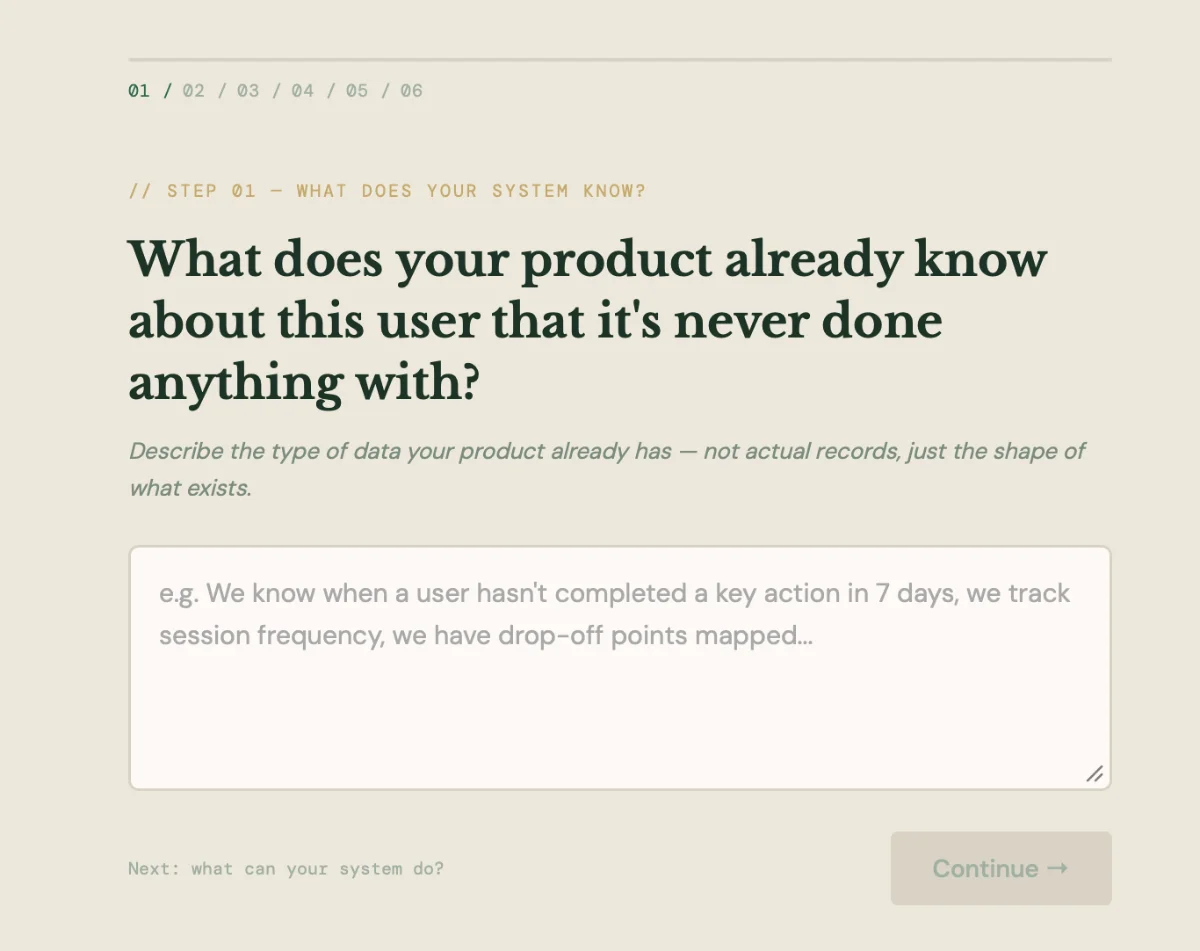
Agent Master walks a team through six structured steps and produces an agent brief — a behavioral contract that engineering, legal, and design can all sign off on before anyone builds. The brief pins down:
And step one is the honest one: whether you need an agent at all. Plenty of "agent" ideas are a form, a filter, or a well-written email. The diagnostic is allowed to say so — a tool that always answers "yes, build it" isn't a diagnostic, it's a sales funnel.
Upstream of everything else
Deployment and governance frameworks are good at controlling an agent once it exists. Agent Master works one step earlier: it defines the behavior those frameworks will enforce. First decide what the agent is allowed to be. Then configure the machinery that holds it to that.
The output is deliberately boring: a document. A brief that engineering can scope from, legal can review, and design can write against — the same artifact, three audiences, no translation loss.
I ran it on my own product first
The first agent brief Agent Master produced was for Samuel Sauntr — the recommendation agent inside Sauntr, the travel discovery app I founded. My product, my data, my risk: the right place to prove the method before pointing it at anyone else's.